⚡ 24/7 Emergency Data Recovery — Engineer responds in 15–20 min · 1-888-749-3786
Hard drive recovery

Hard Drive Recovery Service — We Recover What Others Can't

Clicking, beeping, grinding, not detected, dropped, or water damaged — if your data is on the platters, we can get it back. Our ISO Class 100 cleanroom engineers have spent 17 years recovering drives that other labs turned away.

96% Success Rate
Since 2009 · 10,000+ drives recovered
15–20 Min Engineer Response
Real engineer, never a bot · 24/7
No Data, No Charge
On qualifying cases · The DRG Recovery Promise
Free UPS Both Ways
Fully insured in transit
Privacy-First Lab
CCPA compliant · HIPAA-ready workflows
Trusted by our clients

Don't just take our word for it.

See what our clients say about getting their data back.

Loading reviews…
How we work

We treat every case
like it's urgent.

Free overnight shipping. 15–20 minute engineer response. Full cleanroom diagnostic. Every single case — no exceptions, no tiers to unlock.

15
Minute responseReal engineer, every call
$0
Shipping costFree UPS Express both ways
$0
If we failNo Data, No Charge
Standard
Your data can wait a few days.
Most personal & business recoveries
📦 5–7 days   

Your device failed but you're not in crisis. Old photos, archived files, a laptop that died last month. We ship you a free prepaid label, assess it in our cleanroom, and send you a full report.

Full Tier 3 cleanroom diagnostic — included in every case
Free overnight UPS Express both ways
Full diagnostic with file list
Written quote before any work begins
Call 1-888-749-3786
⚡ Priority
Your business is feeling the impact.
Servers, workstations, time-sensitive data
⚡ Front of queue

You can still operate, but the clock is ticking. A failed server, a critical workstation, client data you need by end of week. Your case moves to the front of the queue.

Everything in Standard
Front-of-queue priority assessment
Dedicated engineer on your case
Daily progress updates
Call 1-888-749-3786
24/7
🔴 Emergency
Your systems are down right now.
Active failures, every hour costs money
🔴 24/7 Recovery

RAID array crashed. Production server offline. Court deadline in 48 hours. Your device gets assessed within 24 hours. Once you approve, recovery starts immediately.

Everything in Priority
Around the clock recovery
Recovery begins immediately after approval
24/7 lab access — nights & weekends
Real-time recovery progress
Expedited secure data return
Your device jumps the queue. Recovery starts the moment you approve. 24/7 lab access, nights and weekends.
Call Now — 1-888-749-3786
Every case — every tier — includes
15–20 min engineer response
ISO Class 100 cleanroom
No Data, No Charge guarantee (qualifying cases)
PC-3000 equipped lab
Free overnight UPS Express
Encrypted data return
Written quote before work
All data deleted after confirmation

Not sure what you need?

Call us — an engineer will assess your situation and recommend the right path.

Call 1-888-749-3786
or

Start Your Case Online →

What Is Your Hard Drive Doing?

Every hard drive failure tells a story. These are the most common symptoms we recover from — and the signals that mean you should stop using the drive immediately and call us.

Clicking or Ticking

A rhythmic clicking sound indicates the read/write heads are failing or have lost alignment. The heads are repeatedly trying to calibrate and failing. Power off the drive immediately — each click cycle risks scratching the platter surface and destroying data permanently.

Beeping on Power-Up

A beeping drive typically means the spindle motor is seized — the platters cannot spin. This is often caused by a head crash where the heads have landed on the platter surface, or by a motor bearing failure. Recovery requires opening the drive in a cleanroom to free the platters and transplant them or repair the motor assembly.

Not Detected by Computer

When your drive is not recognized by BIOS, Disk Management, or your operating system, it often indicates a PCB failure, firmware corruption, or severe head damage. The drive may spin normally but simply cannot communicate with your system. Our engineers diagnose the exact failure point and restore communication to access your data.

Grinding or Scraping

Grinding sounds are among the most serious symptoms — they indicate the read/write heads are in direct contact with the platter surface. This is an active head crash. Every second the drive remains powered on, the heads are physically scraping data off the platters. Power off immediately and do not attempt to power on again. Call us at 1-888-749-3786.

Dropped or Impact Damage

A hard drive dropped while powered on almost always suffers a head crash — the impact forces the read/write heads into the platter surface. Even a drop from desk height can cause catastrophic damage. Drives dropped while powered off may have dislodged heads, damaged spindle bearings, or cracked platters. Do not power on a dropped drive — bring it directly to our cleanroom for assessment.

Water or Fire Damage

Water, flooding, and fire expose drive internals to contaminants that corrode the platters and heads. Time is critical — the longer contaminants sit on the platter surface, the more data is destroyed. Do not attempt to dry, clean, or power on a water-damaged drive. Ship it to us sealed in a plastic bag. Our cleanroom environment allows us to clean and recover platters that would otherwise be written off.

Inside Our ISO Class 100 Cleanroom

Every hard drive recovery begins here — a particle-free environment where a single speck of dust can destroy a platter. Our Tier 3 lab in London, Ontario is one of the most controlled recovery environments in Canada. Fewer than 100 airborne particles per cubic foot. The same standard used in semiconductor manufacturing and surgical operating rooms.

Why Hard Drives Fail

Hard drives are precision mechanical devices with moving parts spinning at thousands of RPM. Understanding why they fail helps you know what to do — and what not to do — when yours stops working.

Mechanical Failure

The most common category of hard drive failure. Read/write head crashes, spindle motor seizures, bearing failures, and actuator arm malfunctions all fall under mechanical failure. These are the drives that click, beep, grind, or refuse to spin. Recovery requires opening the drive inside an ISO Class 100 cleanroom, replacing the failed components with precision-matched donor parts, and imaging the platters sector by sector. Our engineers have 17 years of experience performing these surgeries on thousands of drives from every major manufacturer.

Logical / File System Failure

The drive hardware works perfectly, but the data is inaccessible. Corrupted file system tables, accidental formatting, deleted partitions, virus or ransomware damage, and operating system failures all cause logical failure. The data is still physically present on the platters — the drive has simply lost the map that tells it where each file lives. Recovery involves creating a forensic image of the drive and reconstructing the file system to locate and extract your files intact.

Firmware Corruption

Every hard drive runs its own internal operating system — the firmware. When firmware modules become corrupted (from power surges, bad sectors in the service area, or manufacturing defects), the drive may spin up but fail to identify itself, report the wrong capacity, or become completely unresponsive. Firmware repair requires specialized tools that can communicate directly with the drive's service area — equipment that most IT departments and general repair shops do not have. Our lab maintains firmware databases for every major drive family.

Physical / Environmental Damage

Drops, impacts, water exposure, fire, power surges, and extreme temperatures cause physical damage that ranges from minor PCB component failure to catastrophic platter destruction. Water-damaged drives require immediate attention — corrosion begins within hours and accelerates over days. Fire-damaged drives may have warped enclosures, melted components, and heat-stressed platters. Our cleanroom allows us to carefully disassemble, clean, and assess physically damaged drives under controlled conditions that prevent further contamination.

Precision Surgery on Your Drive

Our engineers examine every platter surface, replace damaged read/write heads, and rebuild the mechanical assembly needed to extract your data — work that requires years of training and equipment most labs simply do not have. Every head swap, every motor transplant, every firmware repair is performed under laminar airflow in our ISO Class 100 cleanroom.

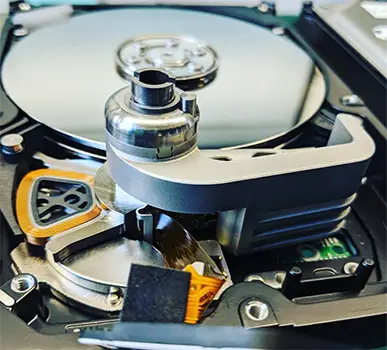
Inside an opened hard drive showing platters and head assembly in cleanroom

What We See When We Open Your Drive

When our engineers open a hard drive inside the cleanroom, they examine every component that can cause failure. Understanding what is inside your drive helps explain why cleanroom conditions are non-negotiable — and why a real cleanroom diagnostic is the difference between recovered data and permanent loss.

The platters are thin, polished discs coated with a magnetic recording layer. Your data lives here — billions of magnetic transitions representing every file, photo, and document you have ever saved. Even a fingerprint or a single dust particle on the platter surface can cause permanent data loss.

Head Comb Assembly — Precision-aligned read/write heads that float nanometers above the platter surface
Platters — Glass or aluminum discs where all data is magnetically stored
Actuator Arm — Moves the head assembly across the platter to read and write data
Spindle Motor — Spins platters at 5,400–15,000 RPM with sub-micron precision
PCB (Printed Circuit Board) — The drive's electronic brain, controlling all operations
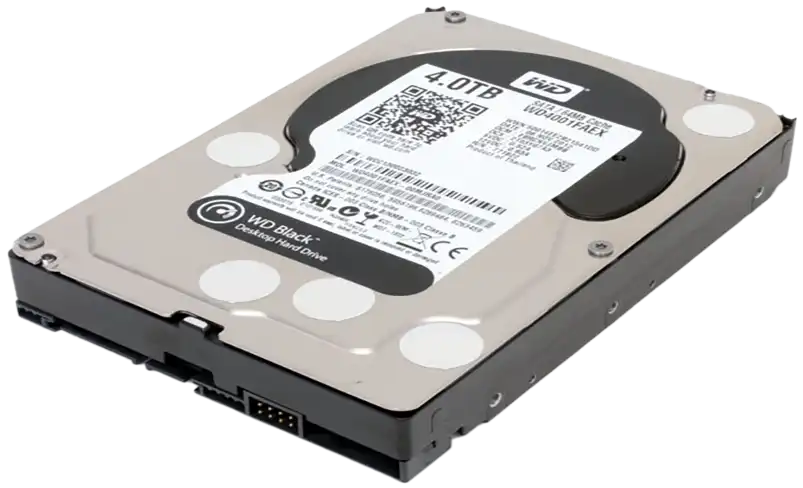
Data Recovery Solutions

See how our engineers approach hard drive recovery — from initial assessment through data extraction and delivery.

From your doorstep to your data — five clear steps, no surprises, no hidden fees.

01

Ship Us Your Drive

Request a free prepaid UPS shipping label. Your drive is fully insured in transit — both ways. Pack it securely, attach the label, and drop it off at any UPS location. Most drives arrive at our lab within 1–2 business days anywhere in the US or Canada.

02

Cleanroom Assessment

Our engineers perform a thorough diagnostic inside our ISO Class 100 cleanroom. We identify the exact failure, assess platter condition, determine recoverability, and provide a detailed report with a fixed recovery quote.

Performed by trained cleanroom engineers · Real lab work, not software scans
03

Review Your Quote

You receive a detailed report explaining exactly what failed, what we found on the platters, and a fixed-price recovery quote. No surprises. You review the exact failure mode we found, the recovery path we recommend, and the fixed-price quote for the work. You decide whether to proceed. No pressure, no hidden fees.

04

Precision Recovery

Our engineers execute the recovery — replacing heads, repairing firmware, imaging platters, or reconstructing file systems as needed. The full recovery process is performed inside our cleanroom under controlled conditions. We keep you updated at every stage.

05

Receive Your Data

We send you a full recovered file list for verification. Your data is returned on an encrypted external drive or via secure digital transfer — whichever you prefer. All copies are deleted from our systems upon confirmation of receipt.

📞 Why Call First?
Why call before you do anything else?
When a drive fails, the worst thing you can do is guess. Every power-cycle of a clicking drive scrapes the platter. Every software scan on a failing SSD risks wear-leveling the last recoverable blocks into oblivion. Every failed RAID rebuild can destroy parity data permanently.
  • Exactly what's happening inside your device right now
  • Whether your case is a qualifying case for our No Data, No Charge guarantee
  • What NOT to do between now and the moment your drive arrives at our lab
  • A clear next step, whether you ship to us or not
No sales pressure. No obligation. Just a real engineer with cleanroom experience answering your questions.
📞 1-888-749-3786
24/7 · Engineer responds in 15–20 minutes

Every Major Hard Drive Manufacturer

Our cleanroom maintains donor parts and firmware databases for all major hard drive families. Regardless of brand, model, or age — if the data is on the platters, we can recover it.

Seagate
Western Digital
Toshiba
Hitachi
Samsung
Maxtor
Fujitsu
HGST
LaCie
🛡️ The DRG Recovery Promise

If we can't recover your data on a qualifying case, you don't pay for the recovery. Full stop. Since 2009.

Most data recovery labs won't put this in writing. We do — because our 96% success rate, our Tier 3 cleanroom, and 17 years of engineering depth mean we're confident enough to stand behind every qualifying case we take.

  • Diagnostic Promise Your device enters our Tier 3 cleanroom for a full engineer-led diagnostic. No software scans. No guesswork. You get a clear written quote before any recovery begins.
  • Recovery Promise On qualifying cases, if we can’t recover your data, you don’t pay for the recovery. We get paid for results, not for trying.
  • Privacy Promise Your recovered data is returned encrypted, and all copies are securely deleted from our systems after you confirm receipt.

A note on qualifying cases. Our guarantee covers the vast majority of drives that come through our lab. Certain cases — fire damage, previously-opened drives, specific legacy drive models, and some encrypted/forensic scenarios — have their own terms because the work is inherently harder to guarantee. Every lab handles these differently. Ours is simple: call us first at 1-888-749-3786 and an engineer will confirm your case status in 15 minutes.

📞 Call 1-888-749-3786 — confirm your case qualifies · 24/7

Everything you need to know about hard drive recovery — answered honestly.

Yes. Clicking is one of the most common symptoms we recover from. It usually indicates a failed or damaged read/write head assembly. Our engineers replace the heads inside our ISO Class 100 cleanroom using donor parts matched to your exact drive model, then image the platters to extract your data. We have a 96% success rate on clicking drive recoveries. The most important thing you can do is power the drive off immediately — continued use causes the damaged heads to scratch the platter surfaces, which can make recovery significantly harder or even impossible.

Call 1-888-749-3786 — an engineer will walk you through your specific situation in 15–20 minutes. 24/7.

Hard drive recovery pricing depends on the device, the failure type, and the complexity of the case — which is why every engagement starts with a real Tier 3 cleanroom diagnostic, not a software scan. Once our engineers have assessed your drive, they'll give you a clear written quote before any recovery work begins. You approve the quote, or you walk away. No surprises.

Call 1-888-749-3786 — an engineer will walk you through your specific situation in 15–20 minutes. 24/7.

Standard hard drive recovery typically takes 5 to 10 business days from the time your drive arrives at our lab. This includes a thorough assessment, parts sourcing if needed, the recovery process itself, and quality verification of the recovered files. Emergency cases can be expedited — call our 24/7 line at 1-888-749-3786 for time-sensitive situations. We provide regular status updates throughout the entire process.

Hard drive platters spin at 5,400 to 15,000 RPM with read/write heads floating just nanometers above the surface. A single particle of dust — invisible to the naked eye — is large enough to cause a head crash that destroys data permanently. Our ISO Class 100 cleanroom maintains fewer than 100 airborne particles per cubic foot, the same standard used in semiconductor manufacturing. Opening a hard drive outside this environment risks contaminating the platters and making recovery impossible. This is why DIY recovery attempts and non-cleanroom labs frequently cause irreversible damage.

Our overall success rate is 96% across all hard drive recovery cases. This includes mechanical failures (clicking, beeping, grinding), logical failures (corrupted file systems, accidental deletion, formatting), firmware corruption, and physical damage from drops, water, or fire. Success depends on the condition of the platters — as long as the platter surfaces are not severely scored or degraded, recovery is almost always possible. Drives that have been opened outside a cleanroom or subjected to repeated power cycles after failure have lower recovery rates, which is why we strongly advise powering off and contacting us immediately.

Do not continue powering on the drive — especially if it is clicking, grinding, or beeping. Every additional power cycle risks further platter damage. Do not open the drive yourself — even in a "clean" home environment, airborne particles will contaminate the platters instantly. Do not attempt DIY recovery software on a physically failing drive — this forces the damaged heads to drag across the platter surface. Do not put the drive in a freezer — this is a myth that causes condensation damage and corrosion. Do not shake or tap the drive — this can dislodge head debris onto the platter. Power it off, keep it in a safe place, and contact our engineers at 1-888-749-3786.

Yes. All data on a traditional hard drive is stored magnetically on the platter surfaces — thin aluminum or glass discs coated with a magnetic recording layer. The read/write heads float nanometers above these platters to read and write data. When a drive fails mechanically, the data on the platters is usually still intact. Our recovery process involves replacing the damaged mechanical components to regain access to the platters, then creating a sector-by-sector image of the drive to reconstruct your files. As long as the platter surfaces have not been physically scratched or degraded, recovery is possible.

Yes, but with an important caveat: we can recover the encrypted data from the platters, but you will need your encryption key or password to decrypt the files after recovery. Hardware-level encryption (like BitLocker, FileVault, or self-encrypting drives) means the data is stored in encrypted form on the platters. We recover the raw encrypted data and return it to you — decryption is then performed using your credentials. If you have lost your encryption key, the recovered data will remain encrypted and inaccessible. We recommend always maintaining a backup of your encryption recovery keys.

Drive failing right now? Every minute counts.

If your device is clicking, not detected, or physically damaged — power it off and step away from it. Every second of power-on can make recovery harder. You don't need to diagnose it yourself. One call to a real engineer — 15–20 minutes — and you'll know exactly where you stand.

No sales pressure. No obligation. Just a trained cleanroom engineer on the phone, 24/7, walking you through exactly what to do next.

Start Emergency Case → Call 1-888-749-3786
Real engineer · Never a bot · Never a call center · 24/7 including nights and weekends

Independent data recovery laboratory. Not affiliated with any device manufacturer or OEM. All brand names referenced are trademarks of their respective owners.